
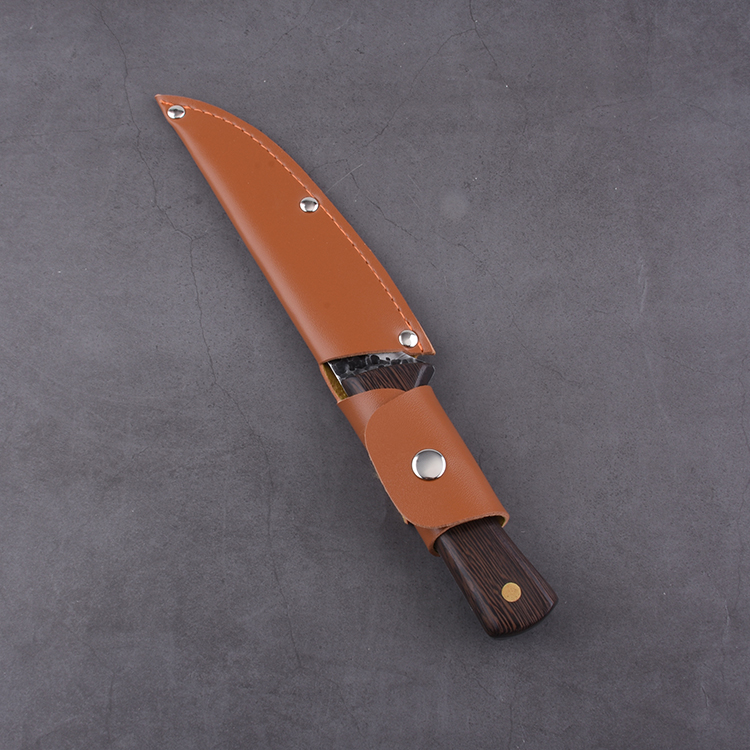

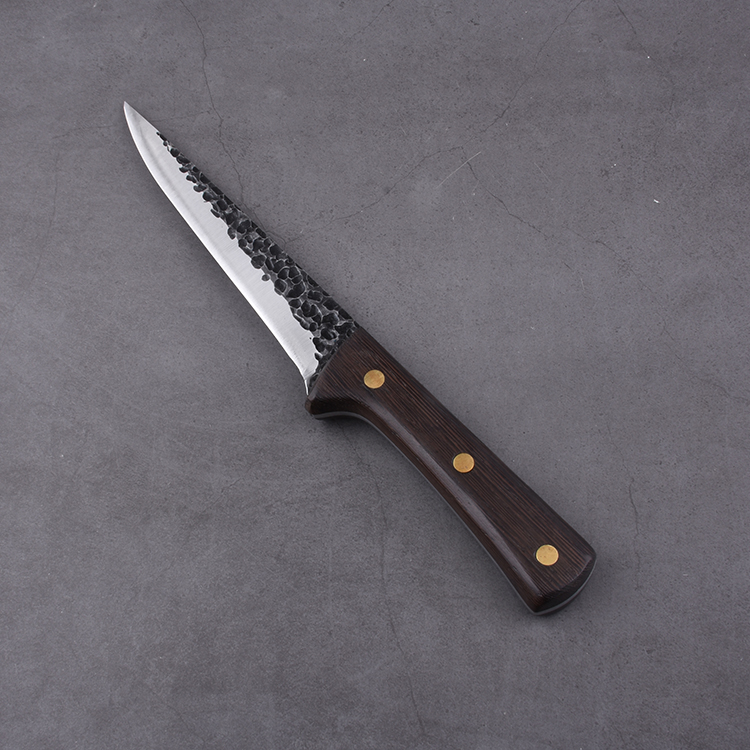

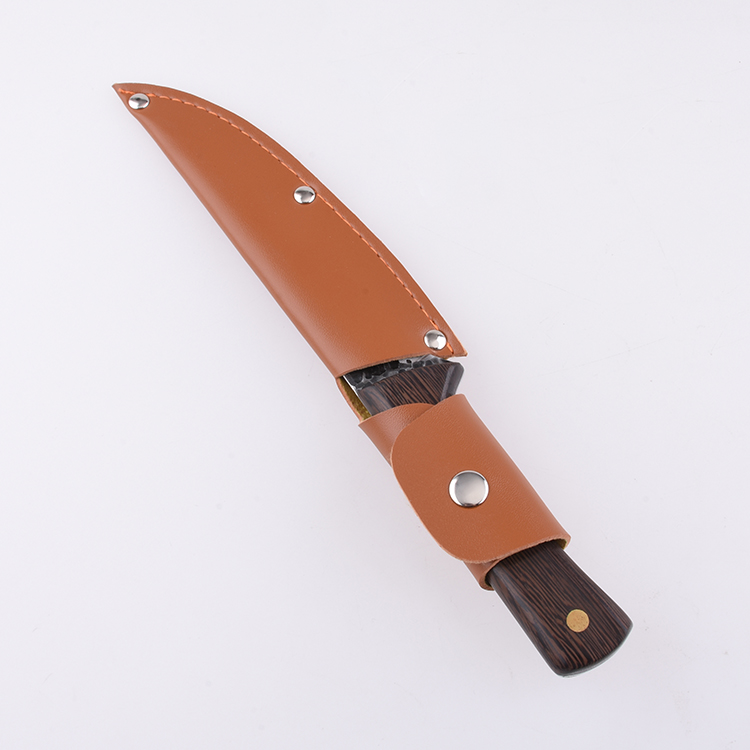
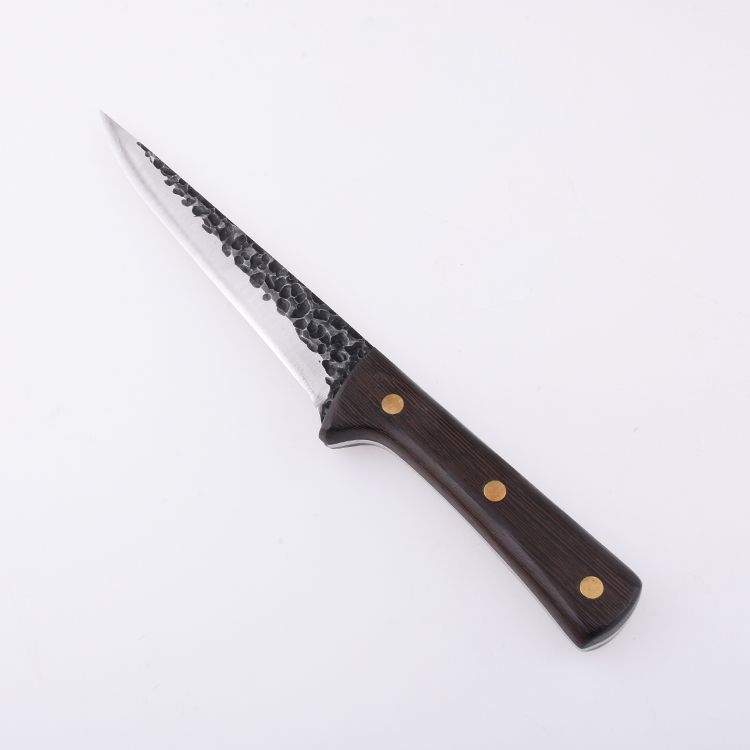


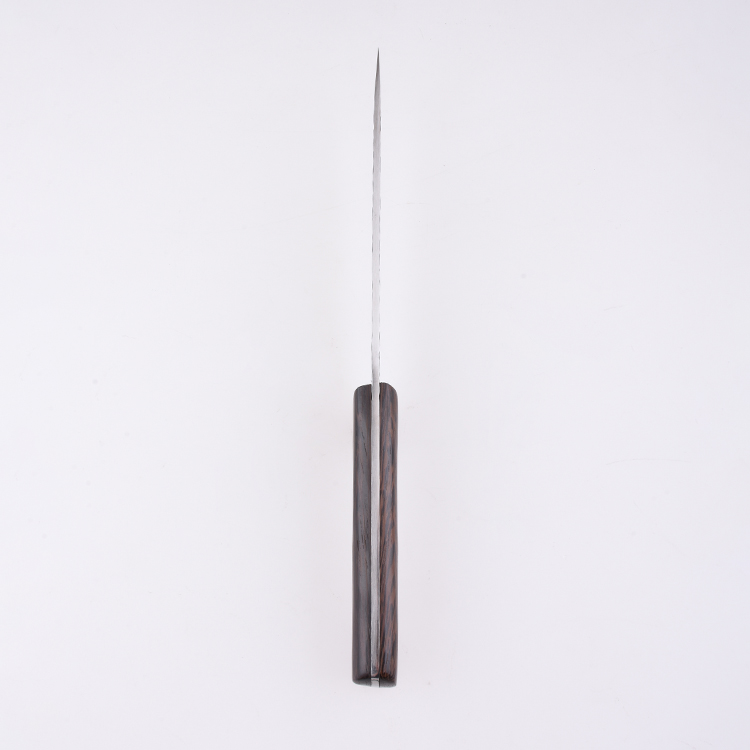
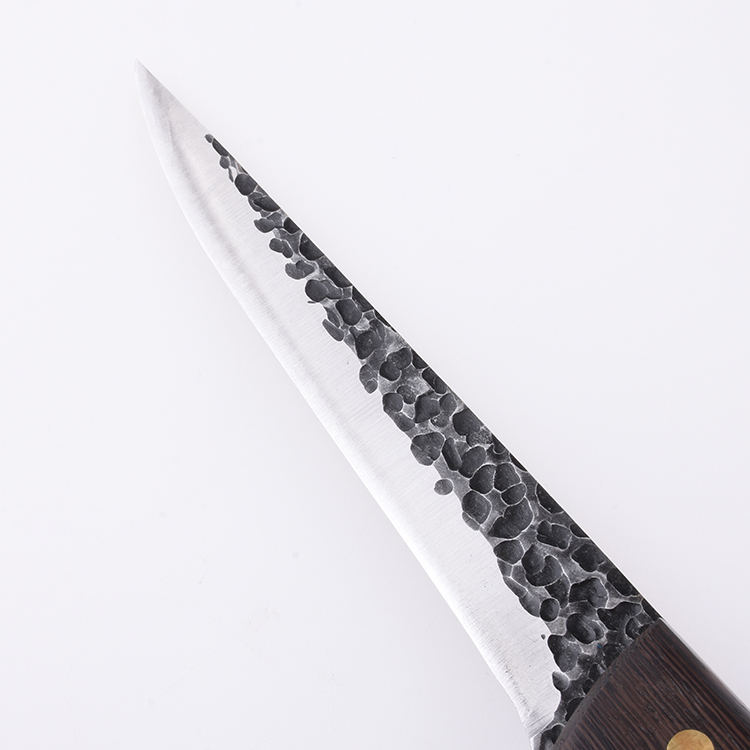



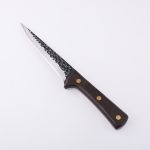


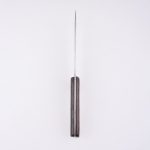
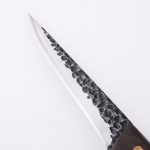
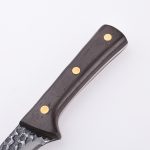

Item NO.: HH-5375
Segment d'articles : Couteaux de boucher
Matériau de la lame : 3Cr13
Matériau du manche : Bois
Blade thickness: 3.3mm/0.13”
Blade length: 153mm/6.02”
Épaisseur de la poignée : 18 mm/0,709"
Total length: 263mm/10.35”
Weight: 175.5g/6.19 oz
Style de lame : Pointe utilitaire
Couleur du manche : Bois
Gaine: gaine en cuir
Finition de la lame : Satinée
Broyage de la lame : Plat
MOQ régulier d'ODM : 1
3Cr13 : C'est un acier inoxydable martensitique avec de bonnes performances d'usinage. Après traitement thermique (trempe et revenu), il présente une excellente résistance à la corrosion, des performances de polissage, une résistance élevée et une résistance à l'usure, et convient à la fabrication pour résister à des charges élevées, une résistance élevée à l'usure et des moules en plastique sous l'action de milieux corrosifs. Après trempe et revenu, le matériau 3Cr13 avec une dureté inférieure à HRC30 a une meilleure maniabilité et il est facile d'obtenir une meilleure qualité de surface.
Utility Point: It is similar to the water drop type tip, but the tip angle is sharp and can be used for puncture. Generally, the portable tools are in a tip mode.
Introducing the basic usage that you should remember to use the knife safely and securely. It can be used in a variety of survival scenes, so please learn how to use it and try camping with a knife.
How to use ①: Cut the meat
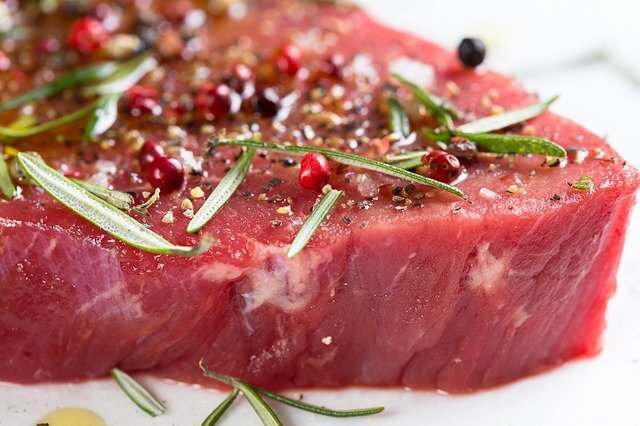
Cooking is one of the pleasures of the outdoors. Simply eating outdoors will make simple dishes even more delicious. Knives made for survival purposes can be used to cut the meat used in cooking.
However, the sharpness is inferior to that of a normal kitchen knife, so the point of use is to cut it so as not to damage the meat. If you try to cut it by force, the meat may be crushed and the deliciousness may be spoiled.
Cut while moving the knife finely
Basically, it is important to move the knife finely and cut it little by little. Even if it doesn’t cut immediately, you can cut it little by little by moving the knife finely.
If there is a saw-shaped part, it is also recommended to utilize it. It cuts off the fibers of the meat and makes it easier to cut. Check the structure of the survival knife and actively use the parts that you can use.
How to use ②: Cut fish
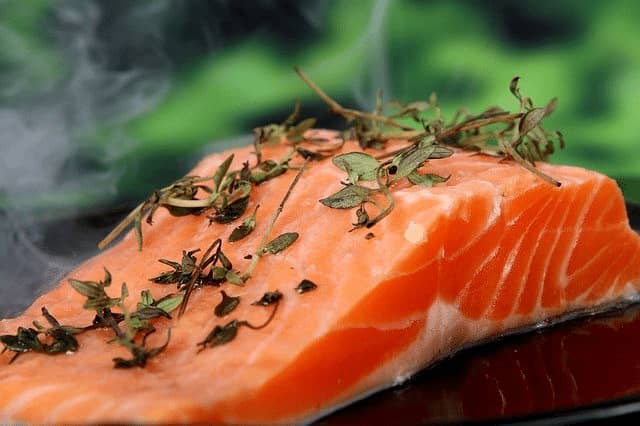
You can also use a survival knife to cut fish for cooking. Let’s learn the basic usage and cook the fish. First, we will do the work of removing scales. Scales may contain germs, and cooking outdoors may increase the risk of food poisoning. Use the back of the knife to carefully remove the scales.
Then drop your head. The point of using a knife is to cut using the line connecting the base of the chest fin and the base of the belly fin as a guide.
Cut your stomach and take out the cotton
Insert a knife into the cut head and slide it towards the tail. When you’re hungry, take out the cotton. After flushing the blood with running water, the pretreatment is complete. Simply bake it, chop it up and put it in the soup, or enjoy it with your favorite cooking method.
How to use ③: Cut vegetables and fruits
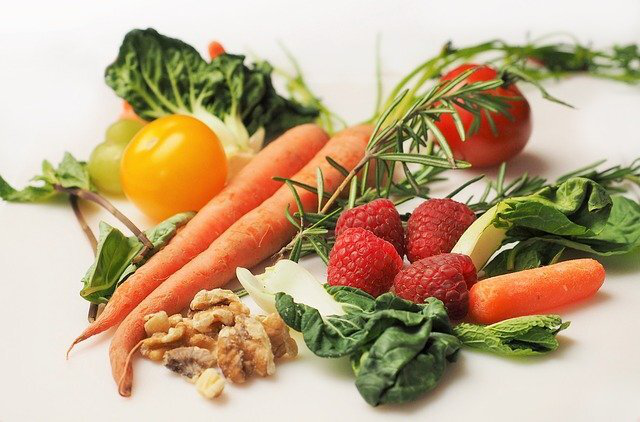
The appeal of survival knives is that you can easily cut vegetables and fruits. Because it uses durable materials, even hard vegetables such as root vegetables can be cut immediately. When cutting vegetables and fruits, the trick is to pull them instead of pushing them with a knife.
Even if you try to push it to cut it, it will not work well, and even soft vegetables and fruits may be crushed. If you move the knife so that it pulls toward you, you can cut it neatly without worrying about crushing it.
Can also be used for peeling
For vegetables and fruits that are worrisome about hard skin, peel and prepare. Hold the survival knife in your dominant hand and the vegetables and fruits in your other hand. Place the blade at an angle and gently press it with your thumb. Slide the knife forward while moving your thumb back.
By repeating this work, you can see that the skin peels off little by little. If you are not accustomed to it, you may get injured if you use it incorrectly, so it is recommended that you practice to get used to it little by little.
How to use ④: Cut the rope

A rope known as a convenient tool for camping. It is not easy to use if it is left for a long time, so you need to cut it appropriately with a survival knife. If you’re not used to it, you’ll want to cut it from the top of the rope, but the opposite is true.
The basic usage is to put a survival knife under the rope and cut it. Once the rope is taut, point the knife blade up and push it up from underneath the rope. If you move the survival knife with the image of sliding it, the rope will break.
There are various ways to use the cut rope
If you cut the rope safely, let’s use it for various purposes. For example, you can pass a rope between trees and attach hooks to hang cooking utensils and lanterns. Also useful for hanging wet clothes and towels to dry.
In full-scale survival, you can also use a waterproof sheet and rope to make an instant tarp. Learn how to cut the rope safely and use it in various survival scenes.
How to use ⑤: Make firewood
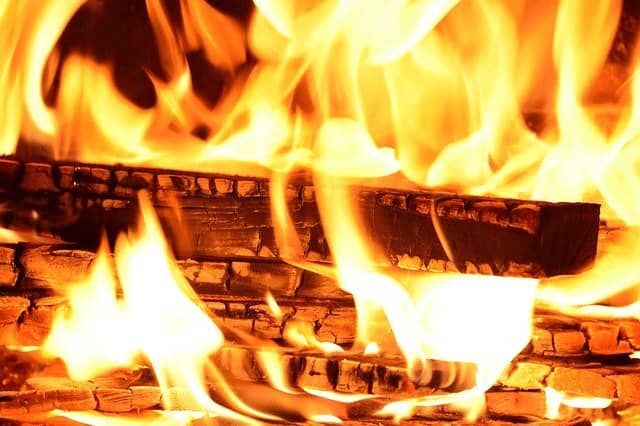
Firewood is necessary for the bonfire, which is indispensable for cooking and warming. Survival knives made from durable materials can cut wood to make firewood.
It is important to remember how to use a survival knife in order to make firewood from the wood around the campsite. If you understand the basic usage, you will be able to easily make the required amount of firewood.

Notre processus de fabrication axé sur la marque vise à fournir aux clients une expérience d'approvisionnement OEM transparente et sans tracas à chaque fois.
01 Envoyez votre demande : faites-nous savoir comment vous souhaitez que votre projet de couteau soit, des conceptions et des matériaux à l'impression et à l'emballage.
02 Obtenez un devis instantané : nous vous fournissons un devis complet, détaillant toutes les dépenses, y compris les frais de matériel et de logistique.
03 Confirmer le prototype:Un prototype fonctionnel est construit sur la base de vos spécifications de conception et vous est envoyé pour test et confirmation.
04 Passez votre commande : une fois que vous êtes satisfait du prototype envoyé, vous pouvez maintenant passer la commande de votre projet de couteau et commencer la production en série.
05 Fabrication et livraison : La production à plein régime du projet de couteau est lancée, ainsi qu'une inspection et un emballage approfondis du produit. La commande complétée vous est ensuite expédiée.
06 Après-vente : notre partenariat ne s'arrête pas à la livraison de la commande, car notre équipe d'assistance client réactive est prête à vous aider et à répondre aux demandes de renseignements dans les plus brefs délais.
Toutes les options de personnalisation
Bord, Longueur de lame, Types de lame, Matériaux de lame, Matériaux de poignée, Mécanisme d'ouverture, Mécanisme de verrouillage

Nous nous soucions de nos clients
Comprenant les demandes croissantes de l'industrie, Shieldon est en mesure de répondre à tous les besoins de nos clients avec efficacité et à un prix abordable. Ayant un accès unique aux meilleurs matériaux du marché, nous sélectionnons les fournisseurs de matériaux les plus réputés pour nos projets. Nous poursuivons également en permanence les dernières tendances en matière de production, de conception et d'emballage pour nous assurer que nos produits sont à la pointe de l'industrie.


 FR
FR  EN
EN  ES
ES  RU
RU  PT
PT  KO
KO  ID
ID  MS
MS  IT
IT  DE
DE  TL
TL