
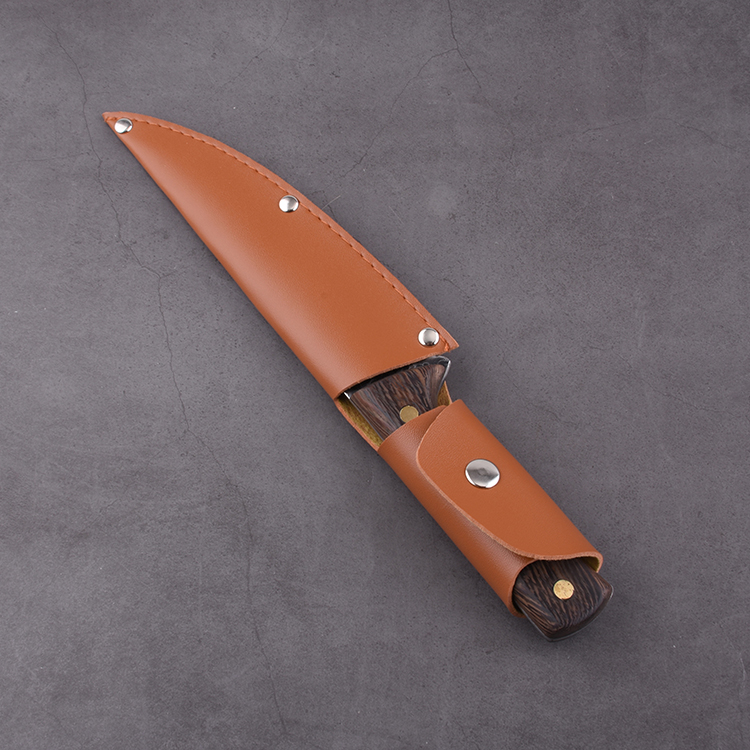
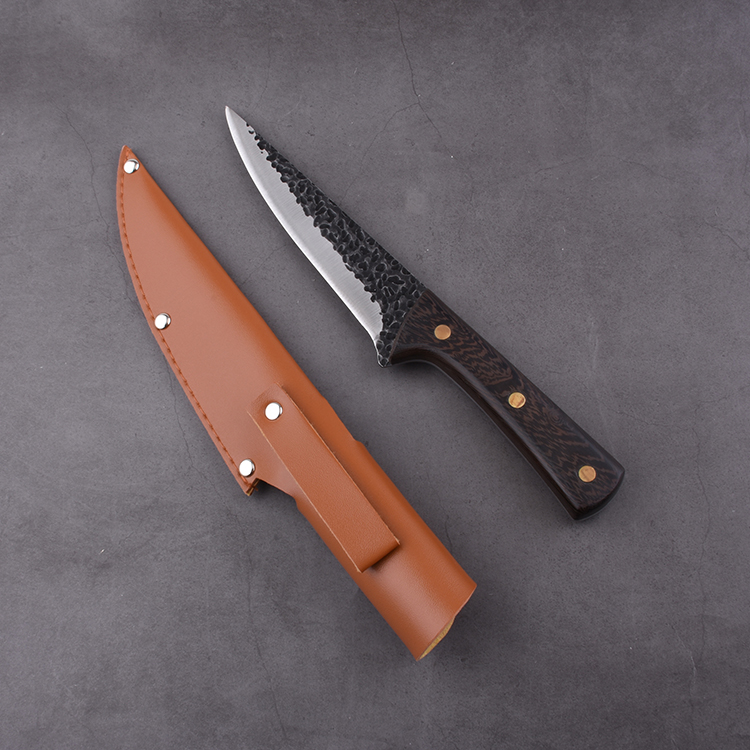
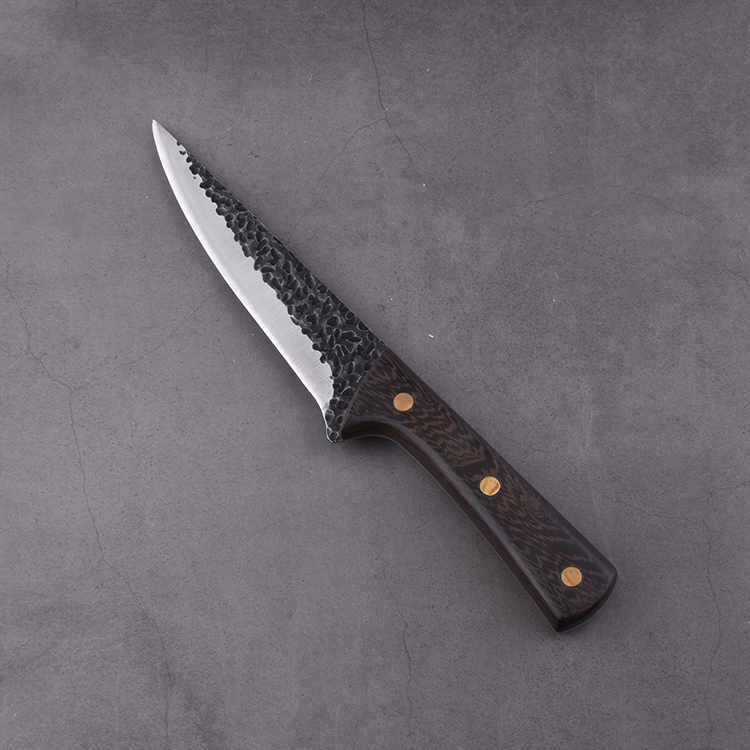
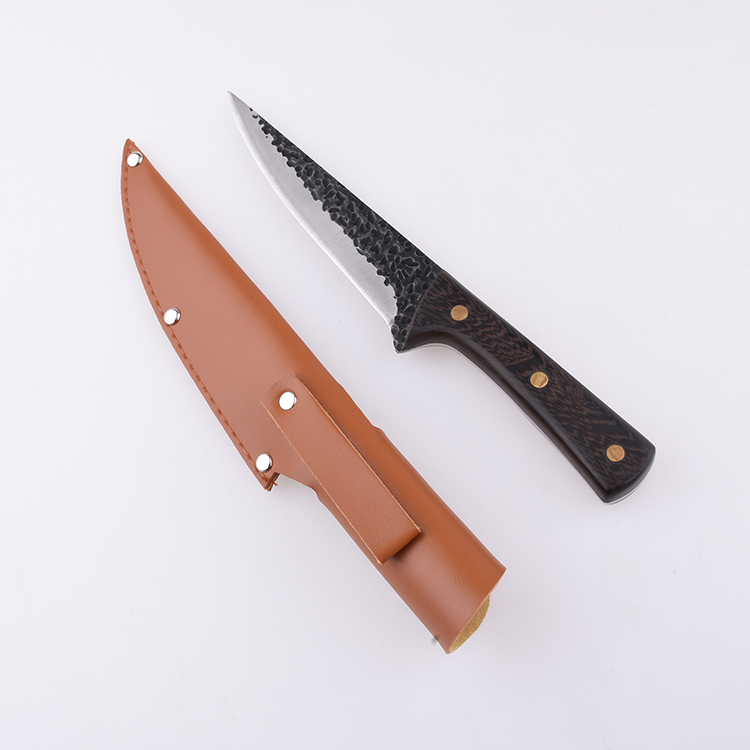


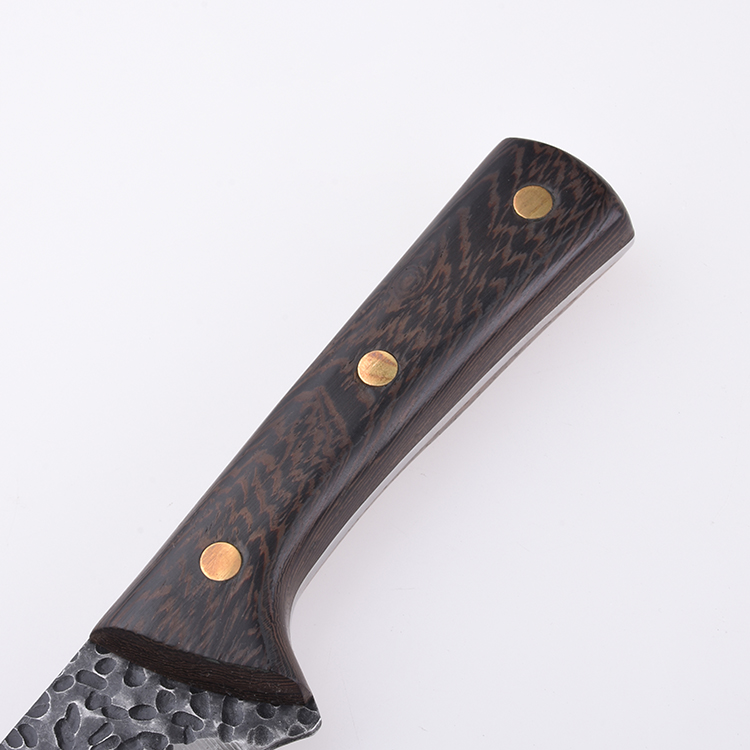
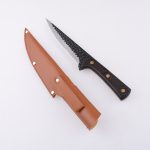
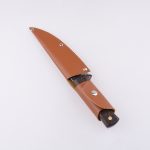
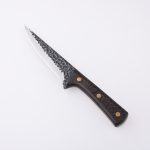
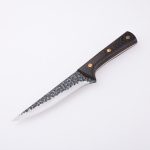
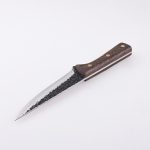
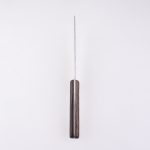
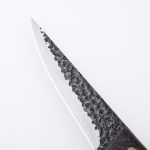

Item NO.: HH-5992
Item segment: Butcher knives
Klingenmaterial: 3Cr13
Griffmaterial: Holz
Blade thickness: 3.2mm/0.126”
Blade length: 159mm/6.26”
Handle thickness: 19.5mm/0.768”
Total length: 259mm/10.2”
Weight: 192g/6.77 oz
Klingenstil: Utility Point
Grifffarbe: Holz
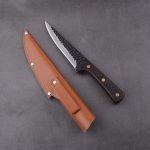
Scheide: Lederscheide
Klingenfinish: Satin
Klingenschliff: Flach
ODM reguläre Mindestbestellmenge: 1
3Cr13: Es handelt sich um einen martensitischen Edelstahl mit guter Bearbeitungsleistung. Nach der Wärmebehandlung (Abschrecken und Anlassen) weist es eine hervorragende Korrosionsbeständigkeit, Polierleistung, hohe Festigkeit und Verschleißfestigkeit auf und eignet sich für die Herstellung, um hohen Belastungen, hoher Verschleißfestigkeit und Kunststoffformen unter Einwirkung korrosiver Medien standzuhalten. Nach dem Abschrecken und Anlassen ist das 3Cr13-Material mit einer Härte unter HRC30 besser bearbeitbar und lässt sich leicht mit einer besseren Oberflächenqualität erzielen.
Utility Point: It is similar to the water drop type tip, but the tip angle is sharp and can be used for puncture. Generally, the portable tools are in a tip mode.
How to choose a batoning knife!
When batoning (splitting firewood), hit the firewood with a blade and use another firewood or rubber hammer to hit the back part to baton. As a result, the base of the knife is heavily burdened, and the knife may break or be injured.
When choosing a batoning knife, the most important point is “strength”. Here, we thoroughly explain how to choose a batoning knife and a guideline! Check how to choose and find the best one even for beginners
How to choose a recommended batoning knife 1: Blade thickness
The first way to choose a batoning knife is “blade thickness”. The thickness of the blade is a factor that is directly linked not only to durability but also to “ease of batoning”. If the blade is thick, the knife itself has the power to spread firewood, so you can easily baton.
If the blade is thin, the knife may get caught in the firewood and may not come off. It is recommended to look for a butting knife with a thickness of 2.5 mm or more as a guide.
Buttoning knife recommended selection method 2: blade length
The second way to choose a batoning knife is “blade length”. When batoning, the blade is driven into the firewood, but if the blade is too short, it will not hit the back and it will be very difficult to crack.
It is recommended that the length is several centimeters longer than the width of the firewood. When batoning, the size and width of firewood vary, but try to find a blade length of 10 cm or more as a guide.
Buttoning Knife Recommended Choice 3: Knife Material
The third is “knife material”. The “stickiness” of the material is important for batoning. The stickier the knife material is, the harder it is to break and the stronger it is to impact.
If you want sharpness, a knife with high hardness is the best, but it is said that it is difficult to achieve both the stickiness and hardness required for a batoning knife.
It is recommended to check the reviews of people who used it in combination with materials such as carbon steel and steel.
Buttoning Knife Recommended Choice 4: Knife Type
The fourth is “knife type”. The type I especially recommend is the “Full Tongue Knife”. It is made of one metal from the blade to the handle (tongue). Therefore, it is not only the root that is easily burdened when batoning, but also the impact and load are wholesaled throughout the knife, so it can be said that it is hard to break.

Unser markenorientierter Herstellungsprozess zielt darauf ab, unseren Kunden jederzeit ein nahtloses und problemloses OEM-Sourcing-Erlebnis zu bieten.
01 Senden Sie Ihre Anfrage: Teilen Sie uns mit, wie Ihr Messerprojekt aussehen soll, vom Design und den Materialien bis hin zum Druck und der Verpackung.
02 Erhalten Sie sofort ein Angebot: Wir unterbreiten Ihnen ein umfassendes Angebot, in dem alle Kosten aufgeführt sind, einschließlich Material- und Logistikgebühren.
03 Bestätigen Sie den Prototyp: Ein funktionsfähiger Prototyp wird auf der Grundlage Ihrer Designspezifikation erstellt und Ihnen zum Testen und zur Bestätigung zugesandt.
04 Geben Sie Ihre Bestellung auf: Sobald Sie mit dem gesendeten Prototyp zufrieden sind, können Sie nun die Bestellung für Ihr Messerprojekt aufgeben und mit der Massenproduktion beginnen.
05 Herstellung und Lieferung: Die Produktion des Messerprojekts wird in vollem Gange begonnen, zusammen mit einer gründlichen Produktinspektion und Verpackung. Die abgeschlossene Bestellung wird dann an Sie versendet.
06 After-Sales: Unsere Partnerschaft endet nicht mit der Lieferung der Bestellung, da unser reaktionsschnelles Kundensupport-Team bereit ist, schnellstmöglich zu helfen und auf Anfragen zu antworten.
Alle Anpassungsoptionen
Rand, Klingenlänge, Klingentypen, Klingenmaterialien, Griffmaterialien, Öffnungsmechanismus, Verschlussmechanismus

Tief verwurzelte Erfahrung in der Messerherstellung
Guangdong Shieldon Technology Co., Ltd., ein 1998 gegründetes Tochterunternehmen von DKS, liefert außergewöhnliche Taschenmesser, Multitools und mehr auf den wettbewerbsintensiven internationalen Markt. Wir konzentrieren uns auf die Entwicklung, Herstellung und Belieferung des globalen Marktes mit funktionellen und zuverlässigen Taschenmessern und Mehrzweckwerkzeugen für den Outdoor- und Alltagsgebrauch. Unsere umfassenden Fertigungskompetenzen zusammen mit unserer hochmodernen Produktionsausrüstung und den Zertifizierungen ISO9001:2015 und ISO9001:2015 garantieren unseren Kunden die Qualität jedes Produkts.


 DE
DE  EN
EN  ES
ES  FR
FR  RU
RU  PT
PT  KO
KO  ID
ID  MS
MS  IT
IT  TL
TL